

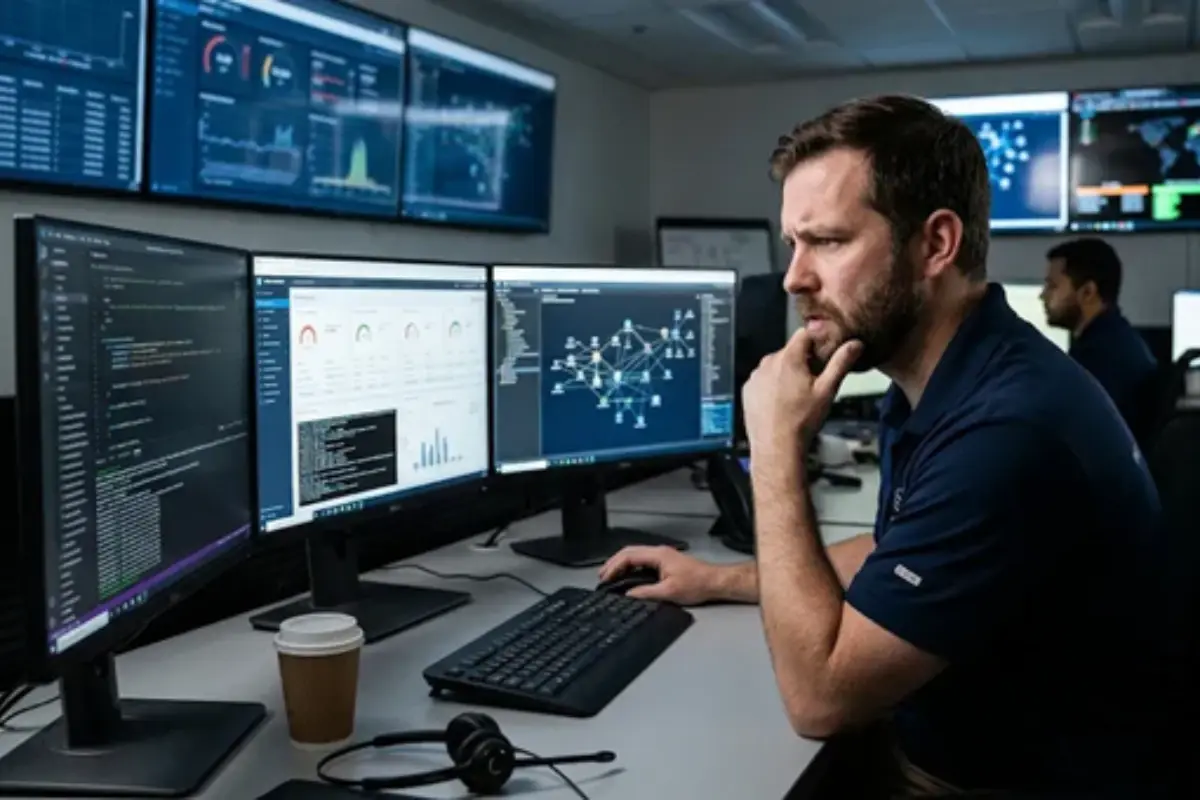
Cyber attacks do not keep business hours. Ransomware is often launched overnight, on weekends, or during holidays, precisely when few people are watching. Most small and mid-sized businesses cannot staff a security team around the clock, which leaves a gap between the alerts their tools generate and anyone who can act on them.
Managed detection and response, usually abbreviated MDR, is designed to close that gap. This guide explains what it is, how it works, and how to tell whether your business needs it.
Table of Contents
What Is Managed Detection and Response?
MDR is a service in which an outside team of security analysts monitors your environment around the clock, investigates suspicious activity, and takes action to contain threats. It combines technology that collects security data with human expertise that interprets it.
The key word is response. Many security products detect problems and then send an alert for someone else to deal with. An MDR service is expected to investigate the alert and, within agreed limits, act on it, such as isolating an infected computer or disabling a compromised account.
How Does MDR Work?
The process follows a few steps. First, software on computers, servers, and often the network and cloud collects activity data, a technology commonly known as endpoint detection and response, or EDR. This data is sent to the provider’s platform, where automated analysis flags unusual behavior.
Next, analysts review the flagged activity to separate real threats from harmless events. When a threat is confirmed, they either take containment actions directly or guide your team through them. Afterward, the provider documents what happened, helps remove the cause, and recommends improvements to reduce the chance of repeat incidents.
How Is MDR Different From Antivirus?
Traditional antivirus compares files against a list of known threats and blocks matches. It is useful, but it struggles against attacks that use legitimate tools, stolen credentials, or entirely new techniques.
Modern endpoint protection looks at behavior, not just files, and MDR adds people who watch the results. Antivirus is automated prevention. MDR is continuous monitoring and response by experts, layered on top of prevention.
How Is MDR Different From Other Managed Security Services?
The terms overlap, which is confusing. A traditional managed security service often focuses on collecting logs, generating alerts, and producing compliance reports, leaving the response to the customer. An MDR service emphasizes investigating and acting on threats.
Security operations center services and monitoring tools such as log management platforms may be components within an MDR offering, but the defining feature is that humans actively investigate and respond. When comparing providers, ask exactly what actions they will take on your behalf and what they will leave to you.
What Does MDR Typically Cover?
Coverage varies, but common elements include monitoring of computers and servers, review of alerts from firewalls and cloud services, investigation of suspicious activity, and containment actions such as isolating devices. Many providers also offer threat hunting, in which analysts proactively look for signs of intrusion rather than waiting for an alert, and guidance after an incident.
Confirm which systems are in scope. Email, cloud applications, identity systems, and network devices are not always included by default.
What MDR Does Not Do
It does not replace patching, strong passwords and multi-factor authentication, backups, or employee training. Its role is to reduce the time between an attack beginning and someone stopping it, but it works best when the basics are in place, and the attack surface is already as small as possible.
It also cannot guarantee that nothing gets through. The aim is to find and contain threats quickly, limiting damage rather than promising none.
Who Needs MDR?
MDR is most valuable for organizations that face real risk but lack a full-time security team. Businesses that handle sensitive data, such as healthcare, financial, and legal organizations, and those subject to compliance requirements often benefit. So do companies whose insurers or clients expect continuous monitoring.
If your IT team is already stretched thin, MDR can also relieve the burden of alert fatigue, giving them time to focus on other priorities.
Questions to Ask Before Choosing a Provider
Ask whether analysts work around the clock and how quickly they respond. Clarify what actions they can take without waiting for your approval and how that authority is defined. Check what systems are covered, how they communicate during an incident, and what reporting you receive.
It also helps to ask how onboarding works, how long it takes to get full visibility, and what happens if you decide to leave. Request examples of how they have handled incidents similar to what your business might face.
How Mindcore Technologies Helps Businesses Detect and Respond to Threats
Mindcore Technologies has spent more than 30 years helping businesses protect their systems and data. Under the leadership of Matt Rosenthal, CEO of Mindcore Technologies, the company delivers IT solutions and services in Miami that include 24/7 threat monitoring, endpoint protection, multi-factor authentication, and rapid incident response, backed by a team that investigates and acts when something looks wrong.
Businesses working with Mindcore get continuous monitoring and response aligned with their environment and compliance needs, without having to build a security operations team of their own.
Conclusion
Managed detection and response gives businesses access to round-the-clock expertise they could not easily build themselves. It combines monitoring technology with analysts who investigate and respond, shortening the time a threat can operate unchecked. It works best alongside solid fundamentals such as patching, multi-factor authentication, and backups, and the right provider will be clear about what they will and will not do for you.
About the Author
Matt Rosenthal is the CEO and President of Mindcore Technologies, a full-service IT consulting and cybersecurity firm serving businesses across Florida, New Jersey, Maryland, South Carolina, Louisiana, Texas, and nationwide.
With more than 30 years of experience in IT leadership, managed services, and technology strategy, Matt has helped organizations across healthcare, financial services, and professional services build security programs that detect and contain threats quickly. He holds an MBA in Technology Management, is a certified Project Management Professional (PMP), and is the host of Digging In, a weekly podcast on success in business, life, and health.